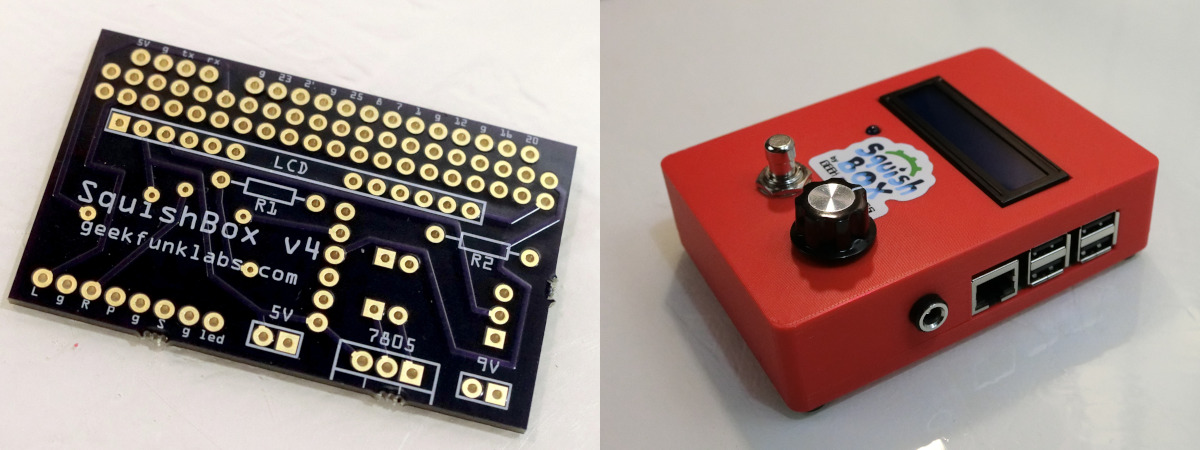
The SquishBox is starting to evolve a little beyond its original guitar-stompbox-inspired design. The latest hardware revision makes a couple of changes that seem small individually, but together make the thing considerably more flexible.
The first is the addition of a rotary encoder. One of the original two stomp switches is replaced by an encoder with a pushbutton, giving the SquishBox a more conventional way to navigate patches and menus. The remaining footswitch is no longer dedicated to a particular function either: it's a general-purpose MIDI input that can be mapped to whatever makes sense for a particular patch or bank. I've also added a status LED that can be controlled by a router rule, so the hardware has a few more ways for the software to communicate what's going on.
Importantly, these aren't really hard-coded hardware functions. The inputs and outputs are connected directly to GPIO, which means there's still plenty of room to use the hardware differently. Want two stomp switches instead of an encoder? That's still possible by changing the GPIO assignments. The idea is to make the physical interface useful without making it dictate what the software has to do.
The other big change is less obvious from the circuit board: I'm no longer building/selling the SquishBox in aluminum Hammond 1590BB enclosures. The original SquishBox was built into essentially a guitar pedal enclosure, which looked great and gave it a satisfying stompbox aesthetic. It also meant cutting rectangular holes in a chunk of aluminum for the LCD and USB ports. Doing that with a jigsaw is loud, awkward, time-consuming, and never quite as satisfying as you imagine it will be when you start.
So, I designed a 3D-printed enclosure. It's a much easier thing for me to manufacture, but I think it's also a better fit for the idea behind the SquishBox. A 3D printer can produce the enclosure with all the weird holes and mounting points already built in, and someone building their own SquishBox doesn't need a drill press and a jigsaw or a collection of specialized tools just to make the box. It's also easier to mount the electronics - for metal enclosures I used 2-part epoxy to glue mounting posts, which didn't work 100% of the time. The 3D-printed enclosure has little tabs so the LCD can snap in place, and there are printed posts on the lid that hold the Pi in place when the lid is closed.
It does lose a little of the cool guitar-pedal factor. There's something undeniably satisfying about a painted aluminum stompbox covered in knobs and sick graphics. But I also like what the more generic enclosure says about what the SquishBox is becoming. It doesn't necessarily have to live on the floor next to a guitar pedalboard. It could sit on a desk, next to a groovebox, or alongside a Eurorack case. It can be a controller, a synthesizer interface, or whatever else somebody finds useful.
Maybe that's a little less sexy, but also a little more agnostic---and, hopefully, a little more democratic. The hardware shouldn't tell you what kind of musician you're supposed to be.